
This past summer we took Mom out for ice cream. Nothing big. Nothing wild. Just a couple of hours away from home—sunshine, a cone, a small slice of normal.
Upon returning, it was readily apparent something was off.
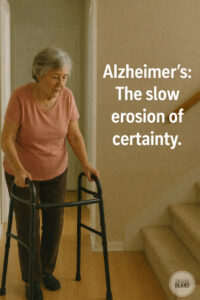
After getting her settled back inside, Mom took her walker and began a determined journey: through the entryway, into the kitchen, across the living room, past her chair, and straight to the stairs. She has not climbed stairs since 2017 and has never traversed these stairs in her life. She stopped there, visibly confused.
We gently asked what she was looking for.
“I need to go up to my room,” she said.
We carefully and calmly redirected her back to her chair that she had just shuffled past across the other side of the room.
She sat, reclined, and had a look upon her face that conveyed a sense of ‘lostness.’ Over time, she leveled out again.
A very similar thing happened this fall after we took her for a “colour drive’ to enjoy the changing leaves and scenery. Upon arriving home, she was very disoriented, much like the ice cream trip.
And we learned (or perhaps relearned) a hard truth: at this point in her journey, even small disruptions to routine can really mess with her internal compass.
Confusion doesn’t announce itself loudly. Sometimes it slips in quietly, disguised as ice cream or a simple drive to see the colours.
This past week Mom was hospitalized for three days. When I picked her up, she was deeply concerned—not about herself, but about her job at the nursing home. (Back in the day she worked at a nursing home)
Apparently, the “kids” working there were running frantically back and forth doing absolutely NOTHING and clearly needed better training. (She was in emerg. It was chaos. She wasn’t wrong about the rushing back and forth just that they were not doing anything.)
She was also worried because we left before she filled out her log book—and she couldn’t remember clocking out. I assured her that someone would care for those details and she didn’t need to worry about them and if needed I could call to ensure it was done.
As we drove toward home, she looked around and asked, “Are we in Campbellford?” I gently said, “No Mom, we’re not in Campbellford, but I can understand why you’d think so – both town are divided by a river running through it.”
She seemed comfortable with that answer.
However, when we did get home she was profoundly disoriented. Much, much more than our previous and short trips out. She continued to talk about her arrival last week for a visit, her work the past few days at the nursing home, and seeing her sister (who is deceased) there from a distance. She also began talking about not visiting her mom and it’s been so long since she had seen her.
Mom does not remember living with us for the past seven years – had begun accusing me of lying to her, even about the community we are living in. But what pains my heart the most is this: three days later, she’s still asking where she’s supposed to sleep, and where the bathroom is. There are vague recollections that happen, for instance, when I walk her into her bedroom suite she will say that she thinks she has stayed here before, the last time she visited maybe.
I cannot even begin to describe the ache in my heart for the confusion she must be living in.
It has been a very interesting journey and I’ve come to realize that Alzheimer’s is not just about memory loss. It is the slow erosion of certainty.
The quiet terror of not knowing where you belong, or whether you’re doing what you’re supposed to be doing. Imagine waking up every day unsure if you’re late, lost, or failing at something that was important to you.
As caregivers, we learn lessons we never signed up for:
- Routine although it can feel quite boring – is absolutely essential to keep them grounded. What feels repetitive to us feels safe to them.
- Redirection is kinder than correction. Being “right” often matters less than being reassuring.
- Humour can coexist with heartbreak. If we can give ourselves permission to laugh, it will greatly reduce the weight and gravity of the situation. We have had plenty of opportunities for laughter along the road.
- Patience is not passive – it’s very active. Yes, it can be exhausting, and deeply loving work, but remember they are not doing this on purpose!
- Their world is shrinking, but their dignity must not.
Some days, caregiving feels like standing on shifting sand. Just when you think you’ve found some solid ground, it shifts and moves again.
And yet, love remains. Love shows up in repeated answers, gentle guiding hands, and the decision—again and again—to meet them where they are not insist they meet us where we are.
Alzheimer’s may steal memories, but it does not erase and individuals worth or value. And while Mom may not always know where she is, she is still deeply known, deeply cared for, and thankfully not left to walk this confusing road alone.
Written with love for our elderly.